Saturday, December 31, 2011

Scientists discover a brain cell malfunction in schizophrenia

Thursday, December 29, 2011

Scientists at The Scripps Research Institute have discovered that DNA stays too tightly wound in certain brain cells of schizophrenic subjects.

The findings suggest that drugs already in development for other diseases might eventually offer hope as a treatment for schizophrenia and related conditions in the elderly.

The research, now available online in the new Nature journal, Translational Psychiatry, shows the deficit is especially pronounced in younger people, meaning treatment might be most effective early on at minimizing or even reversing symptoms of schizophrenia, a potentially devastating mental disorder associated with hallucinations, delusions, and emotional difficulties, among other problems.

"We're excited by the findings," said Scripps Research Associate Professor Elizabeth Thomas, a neuroscientist who led the study, "and there's a tie to other drug development work, which could mean a faster track to clinical trials to exploit what we've found."

A Promising New Field

Over the past few years, researchers have increasingly recognized that cellular-level changes not tied to genetic defects play important roles in causing disease. There is a range of such so-called epigenetic effects that change the way DNA functions without changing a person's DNA code.

One critical area of epigenetic research is tied to histones. These are the structural proteins that DNA has to wrap around. "There's so much DNA in each cell of your body that it could never fit in your cells unless it was tightly and efficiently packed," said Thomas. Histone "tails" regularly undergo chemical modifications to either relax the DNA or repack it. When histones are acetylated, portions of DNA are exposed so that the genes can be used. The histone-DNA complexes, known as chromatin, are constantly relaxing and condensing to expose different genes, so there is no single right or wrong configuration. But the balance can shift in ways that can cause or exacerbate disease.

DNA is the guide that cellular machinery uses to construct the countless proteins essential to life. If portions of that guide remain closed when they shouldn't because histones are not acetylated properly, then genes can be effectively turned off when they shouldn't be with any number of detrimental effects. Numerous research groups have found that altered acetylation may be a key factor in other conditions, from neurodegenerative disorders such as Huntington's disease and Parkinson's disease to drug addiction.

A Good Idea

Thomas had been studying the roles of histone acetylation in Huntington's disease and began to wonder whether similar mechanisms of gene regulation might also be important in schizophrenia. In both diseases, past research in the Thomas lab had shown that certain genes in sufferers were much less active than in healthy people. "It occurred to me that we see the same gene alterations, so I thought, 'Hey, let's just try it,'" she said.

Working with lead author Bin Tang, a postdoctoral fellow in her lab, and Brian Dean, an Australian colleague at the University of Melbourne, Thomas obtained post-mortem brain samples from schizophrenic and healthy brains held at medical "Brain Banks" in the United States and Australia. The brains come from either patients who themselves agreed to donate some or all of their bodies for scientific research after death, or from patients whose families agreed to such donations.

A great deal of epigenetic research has focused on chemical alterations to DNA itself. Histone alterations have been much more difficult to study because such research requires that the histones and DNA remain chemically intact. Many researchers feared that these bonds were disrupted in the brain after death. However, Thomas's group was able to develop a technique for maintaining the histone-DNA interactions. "While many people thought this was lost, we were able to show that indeed these interactions are preserved in post-mortem brain, allowing us to carry out these studies," said Thomas.

Compared to healthy brains, the brain samples from subjects with schizophrenia showed lower levels of acetylation in certain histone portions that would block gene expression. Another critical finding was that in younger subjects with schizophrenia, the problem was much more pronounced.

Need for New Treatment Options

Just what causes the acetylation defects among schizophrenic subjects?what keeps certain pages of the DNA guide closed?isn't clear, but from a medical perspective it doesn't matter. If researchers can reliably show that acetylation is a cause of the problem, they can look for ways to open the closed guide pages and hopefully cure or improve the condition in patients.

Thomas sees great potential. Based on the more pronounced results in younger brains, she believes that treatment with histone deacetylase inhibitors might well prove helpful in reversing or preventing the progression of the condition, especially in younger patients. Current drugs for schizophrenia tend to treat only certain symptoms, such as hallucinations and delusions, and the drugs have major side effects including movement problems, weight gain, and diabetes. If deacetylase inhibitors effectively treat a root cause of the disease and prove sufficiently non-toxic, they might improve additional symptoms and provide a major expansion of treatment options.

Interestingly, some of the cognitive deficits that plague elderly people look quite similar biologically to schizophrenia, and the two conditions share at least some brain abnormalities. So deacetylase inhibitors might also work as a treatment for age-related problems, and might even prove an effective preventive measure for people at high risk of cognitive decline based on family history or other indicators.

###

This study, "Disease- and age-related changes in histone acetylation at gene promoters in psychiatric disorders," was supported by the National Institutes of Health. Samples were provided by the Harvard Brain Tissue Resource Center, and Australia's Victorian Brain Bank Network. For more information on the research, see http://www.nature.com/tp/journal/v1/n12/abs/tp201161a.html

Scripps Research Institute: http://www.scripps.edu

Thanks to Scripps Research Institute for this article.

This press release was posted to serve as a topic for discussion. Please comment below. We try our best to only post press releases that are associated with peer reviewed scientific literature. Critical discussions of the research are appreciated. If you need help finding a link to the original article, please contact us on twitter or via e-mail.

This press release has been viewed 103 time(s).

Source: http://www.labspaces.net/116338/Scientists_discover_a_brain_cell_malfunction_in_schizophrenia

jodie fisher zooey deschanel michael jordan ryan braun yvette prieto hypertrophic cardiomyopathy maurice sendak

Apple considers hydrogen batteries

Sorry, Readability was unable to parse this page for content.

Source: http://www.energyharvestingjournal.com/articles/apple-considers-hydrogen-batteries-00004042.asp?rsstopicid=474

apocalypse now happy veterans day happy veterans day brian eno tomb of the unknown soldier tomb of the unknown soldier reo

Friday, December 30, 2011

Google Plus can reach 400 million users in 2012, already has 62 million says unofficial statistician

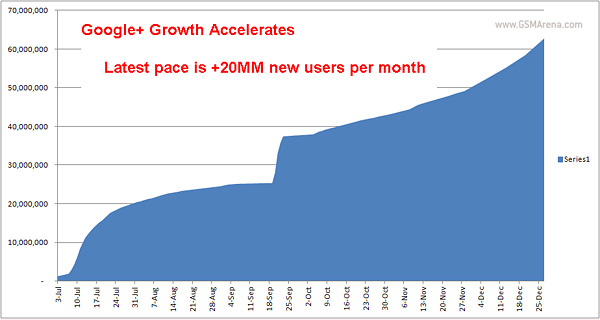
Google may have finally found a solution to the social networking problem that has eluded them for years ? Google Plus is populated by 62 million users and will hit 400 million by the end of 2012, according to self-proclaimed ?unofficial statistician? Paul Allen (no, not that Paul Allen).

The last official figure we got was 40 million users, but that was way back in October. Allen?s estimates put the growth rate of Google Plus at 625,000 new users per day. At this rate, Google Plus will hit the 100 million users mark before the end of February and 200 million in August.

By end of the 2012 that number grows to 293 million. But Paul Allen bets the number of newcomers per day will increase, so Google Plus will actually have 400 million users by the end of next year.

Now, Allen may have a tendency to overestimate the number of users ? for example, he reported 50 million users at the end of September, then in October Google came out with an official number of 40 million.

Still, if Google manages to attract even just 200 million users to its social network in less than two years, it will be an amazing feat. It took Facebook about 4 years to hit that mark in April 2009 (though they?ve grown to 800 million since then).

Source

Source: http://blog.gsmarena.com/google-plus-can-reach-400-million-users-in-2012-already-has-62-million-says-unofficial-statistician/

florida marlins ncaa basketball boise state football boise state football jack and jill uss carl vinson holly marie combs

Company sues former employee over right to Twitter followers

How much are Twitter followers worth? That's the question that will be asked by a Californian court after a former employee of news and reviews site PhoneDog took his followers with him when he changed jobs.

MadDog didn't take too kindly to this, especially as he changed the name of his account from @Phonedog_Noah to @noahkravitz when he left in October 2010. He had over 17,000 followers at the time, a number that has now risen to over 23,000.

PhoneDog wants damages of $2.50 a month per follower over a period of eight months - a total of $340,000.

The argument is over whether the followers actually constitute a customer database.

PhoneDog Media told the New York Times that "the costs and resources invested by PhoneDog Media into growing its followers, fans and general brand awareness through social media are substantial and are considered property of PhoneDog Media L.L.C."

Issues like these can only become more common. The BBC was criticised for letting nearly 60,000Twitter followers go when political correspondentLaura Kuenssberg joined ITV.

Laywers have warned that such issues need to be written into employment contracts.

Via the New York Times.

Source: http://feedproxy.google.com/~r/techradar/all-blogs/~3/vo5VnshgS2U/story01.htm

anya ayoung chee peru earthquake peru earthquake big 12 last minute halloween costumes rum diary klipsch image s4

Thursday, December 29, 2011

Wall Street closes trading day flat

By Reuters

U.S. stocks closed flat Tuesday after strong consumer confidence data, but the?minimal gains were seen as transient in a volatile market after a 5 percent rally over the past four trading sessions.

The S&P 500 turned positive for the year on Friday, with improving economic data helping to boost equities. The gains, which lifted the benchmark index above its 200-day moving average, were amplified by the light pre-holiday trading.

In the latest economic data, consumer confidence rose more than expected in December, hitting an eight-month high, as Americans grew more upbeat about the labor market and their financial situations.

"Once again, the report seems to be heading in the right direction," said Andrew Wilkinson, chief economic strategist at Miller Tabak & Co in New York.

Especially, the improvement in sentiment about the job market "continues to support the theory that the labor market is undergoing a healthy rebound."

In company news, Sears Holdings Corp slid 24.4 percent to $34.68 to its lowest in nearly three years. The retailer plans to close 100 to 120 Kmart and Sears stores and said fourth-quarter earnings would fall by more than half from a year ago.

The outlook from Sears dragged on other retailers. JC Penney shares fell 1 percent to $35.33, while Morgan Stanley's retail index slipped 0.5 percent. Sears' stock fell to its lowest since March 2009.

According to preliminary calculations, the Dow Jones industrial average fell 2.27 points, or 0.02 percent, at 12,291.73. The Standard & Poor's 500 Index was up?0.14 points, or 0.01 percent, at 1,265.47. The Nasdaq Composite Index was up?6.56 points, or 0.25 percent, at 2,625.20.

For the year, the Dow is up 6.3 percent and the Nasdaq is down 0.8 percent. The S&P's performance is turning out to be the flattest in more than 40 years. The index is up less than 1 percent, which is its smallest move in either direction since 1970.

Equity markets often benefit from seasonal strength into the end of the year -- a phenomenon known as the "Santa Claus rally." The last five days of the year and the first two of January have produced an average 1.6 percent gain for the S&P 500 since 1969, according to the Stock Trader's Almanac.

However, investors have warned about reading too much into the year-end rally. They warn that the outlook for the year ahead is still murky with many of the same problems that dogged markets in 2011 still unresolved.

"Lest anyone get too excited, this relatively constructive outlook heading into 2012 represents only a brief reprieve from elevated equity volatility," said Jim Strugger, a derivatives strategist at MKM Partners in a note.

The CBOE Volatility Index VIX, Wall Street's so-called fear gauge, shot up 5.5 percent to 21.87, but traders said the gains were mostly technical after traders adjusted their positions ahead of the three-day holiday.

"Now that we are back, market makers are raising volatility, putting premiums into the VIX cash. January futures are in at around $25.50. We are seeing the holiday effect," said Jamie Tyrrell at Group 1 Trading in Chicago.

U.S. single-family home prices fell slightly more than expected in October, according to S&P/Case-Shiller data, coming after better-than-expected data on the sector last week.

MetLife Inc, the largest U.S. life insurer, will sell about $7.5 billion worth of deposits in its MetLife Bank to a General Electric Co unit as it looks to exit the banking business. MetLife rose 1.3 percent to $31.49 while GE lost 0.7 percent at $18.10.

Copyright 2011 Thomson Reuters. Click for restrictions.

Source: http://bottomline.msnbc.msn.com/_news/2011/12/27/9747009-wall-street-closes-trading-day-flat

christmas lights canon eos rebel t3 christmas photo cards ar 15 costco kmart urban meyer ohio state

Video: Injured model spent Christmas with family


>>> more good news to report on the recovery of a young model from texas who suffered serious injuries when she walked into a plane's spinning propeller. "today" national correspondent amy robach has the latest.

>> lauren scruggs family says she spent christmas surrounded by loved ones and has an entire community coming out to offer support.

>> lauren is doing amazingly well. accidentally walked into the propeller, suffering severe injuries to her head, shoulders and hands. doctors had to remove her hand and her left eye , but the scruggs family remains positive. on monday, the day after christmas , lauren 's mother posted an update on her daughter's blog saying "lo is making remarkable strides. her spirit is incredible. she's positive, hungry and cheery. her appetite is very healthy, even though she is still taking lots of pain medication ." this year the family says christmas served as a reminder sometimes it's the simple things in life that bring great joy, saying "britt and lo wore their matching pjs just for christmas eve . love has been poured out over us in ways we could never have dreamed. our hearts are changed. our lives are molded in a deeper way. lo has twin sister brittany to lean on and brit can literally feel her sister's pain. being twins and having a bond that most never understand, brit's eye has been twitching for the last four to five days every 30 seconds or so." they are still tallying the money raised at last night's fund-raiser. so far the total is at $10,000 and counting. matt?

>> amy robach , thank you very much.

Source: http://video.today.msnbc.msn.com/today/45803640/

nba season iron bowl iron bowl bo jackson bo jackson ibogaine michigan football

Wednesday, December 28, 2011

Animal Center packed with stray pets | KXAN.com

AUSTIN (KXAN) - The Austin Animal Center is dozens of dogs over capacity and expecting a spike in strays over the New Year's weekend.

" What happens typically is we get a huge influx of animals that break free and right now the shelter can 't absorb that capacity," said shelter director Abigail Smith. "We're really nervous about what will happen this weekend."

Smith said most of the dogs in the shelter are strays, and many of them clearly were pets.

" You look in each of these animals and each of these cages and these animals are not homeless, they came from someone's home. Some of them have collars. Some of them are freshly groomed," she said.

Sharla Bullock spent part of her afternoon in the shelter, picking up her dog Janice, who went missing a week earlier.

"I was so happy when they called the day after Christmas," she said, tearing up. "I was really happy."

Janice wore a collar with a tag, and had a microchip. Even so, it took Bullock some time to track her down.

"Make sure you notify everybody you can, give them pictures and keep calling," she advised. "My little dog is like a member of the family."

Smith said more people need to take Bullock's approach and check in with the shelter right away. She said the best way is to come to the shelter, but the Austin Animal Center also keeps pictures of all animals it takes in online.

The city holds the dogs three days, before opening them up for adoption.

" If you show up on day five and we adopted out your pet on day four we cant help you get your pet back," she said.

The shelter has moved dozens of dogs into foster care and non-profit shelters like Austin Pets Alive. They still had to move small dogs into cat cages.

" We'll be creative. I don't feel like animals should have to lose their lives because there are fireworks at night," said Smith. "We'll do everything we can to make room for animals who find their way to the shelter, but we're asking the community to do everything they can to prevent animals from coming here to begin with."

The shelter will give out free collars, tags and microchips at an event Friday and Saturday.

The event will run between 11 a.m. and 7 p.m. Friday, and 11 a.m. to 5 p.m. on Saturday at the Austin Animal Center.

Source: http://www.kxan.com/dpp/news/local/austin/animal-center-packed-with-stray-pets

unemployment rate pentatonix nicki minaj barbie doll nicki minaj barbie doll black dahlia drew drew

Automotive Auction In Sacramento | Cheap Home Ideas

google_ui_features = "rc:10"; //-->

In the first place, long time in the past, when the first automobile appeared and the automobile business was born this way of transportation was seen more as a hobby. The ordinary people would nonetheless use the previous ways of transportation. So the car?s utility wasn?t absolutely understood not till within the 20th century. Now the automobile is an object that?s now not thought to be a hobby but a should, it?s now an utility. People can no longer imagine their world with out the automobile.

Unfortunately for some of us, vehicles are still too expensive. Not everybody can afford to spend some huge cash on new cars. That is why the automotive auctions are so profitable today. One of these public sale is used in plenty of nations, and is now a common practice.

In the United States the number of automotive auctions has elevated since a number of years in the past and is constantly increasing. There are car auctions in every metropolis, there are automotive auctions in L.A, automotive auctions in New York, automobile auctions in Sacramento, and so on.

The automotive public sale in Sacramento for instance, has nothing more or less from the automotive public sale in L.A. All the car auctions work across the same idea: used vehicles that people should buy for a lower price.

What are Automotive Auctions Actually about?

For dealers, the automobile public sale is a good market, a marketplace stuffed with opportunities and a very important a part of their business. The car public sale represents the assembly point the place both socializing and large transactions take place.

As a result of we first took the example of the car public sale in Sacramento let us continue with this one. Automobiles end up at an automobile public sale for all form of reasons. It is the same here, with the automotive public sale in Sacramento. One of the the reason why automobiles find yourself at an automobile auction, for instance at the automotive auction in Sacramento, is their age.

Many dealers provide all form of leases and other sorts of facilities. When returned, these ?off-lease? vehicles will end up at a car auction. This occurs because it?s a lot easier and also more convenient for the dealership to use the automobile auction system as a substitute of just attempting to sell them and place them in an automobile lot, especially if the autos are properly used.

Another method how automobiles can end up at an automotive public sale is that their companies are trading them. The companies? automobiles are normally traded after some years, and the automobile auction is the most effective place where they can be sold. That?s the reason the automobile public sale is the best place where you can either sell or purchase an used car. It is the same at all the automobile auctions, no matter their location, and it?s the same at the automobile auction in Sacramento too, simply in case you have been asking.

Cari F Jaminet

If you want more info concerning Vuaxhall Corsa, visit the author?s website without hesitation.

Source: http://cheaphomeideas.com/automotive-auction-in-sacramento/

cyber monday best deals brownback brownback salvia cybermonday deals cybermonday deals steve johnson

Tuesday, December 27, 2011

Yemen's leader causes headaches in Washington

FILE - In this Dec. 24, 2011 file photo, Yemen's President Ali Abdullah Saleh speaks during a news conference at the Presidential Palace in Sanaa, Yemen. The Obama administration is weighing an unprecedented diplomatic act _ whether to bar a friendly president from U.S. soil. American officials were evaluating on Tuesday an awkward request from Yemeni strongman and longtime U.S. counterterrorism partner Ali Abdullah Saleh. Saleh has said he plans to come to the United States for medical treatment for injuries suffered in a June assassination attempt, and he has asked for a U.S. visa for entry to the country. (AP Photo/Mohammed Hamoud, File)

FILE - In this Dec. 24, 2011 file photo, Yemen's President Ali Abdullah Saleh speaks during a news conference at the Presidential Palace in Sanaa, Yemen. The Obama administration is weighing an unprecedented diplomatic act _ whether to bar a friendly president from U.S. soil. American officials were evaluating on Tuesday an awkward request from Yemeni strongman and longtime U.S. counterterrorism partner Ali Abdullah Saleh. Saleh has said he plans to come to the United States for medical treatment for injuries suffered in a June assassination attempt, and he has asked for a U.S. visa for entry to the country. (AP Photo/Mohammed Hamoud, File)

Protesters chant slogans during a demonstration demanding the prosecution of Yemen's President Ali Abdullah Saleh in Sanaa, Yemen, Tuesday, Dec. 27, 2011. (AP Photo/Hani Mohammed)

(AP) ? The Obama administration is weighing an unprecedented diplomatic act ? whether to bar a friendly president from U.S. soil.

American officials were evaluating on Tuesday an awkward request from Yemeni strongman and longtime U.S. counterterrorism partner Ali Abdullah Saleh. Saleh has said he plans to come to the United States for medical treatment for injuries suffered in a June assassination attempt, and he has asked for a U.S. visa for entry to the country. Fearful of appearing to harbor an autocrat with blood on his hands, the Obama administration was trying to ensure that Saleh visits only for medical care and doesn't plan to stay, U.S. officials said.

Washington's hesitation reflects the shifting alliances and foreign policy strategy prompted by a year of upheaval in the Arab world. Saleh has served as an American ally against al-Qaida and will soon transfer power under a U.S.-backed deal with Yemen's opposition aimed at ending months of instability. He isn't subject to any U.S. or international sanctions.

But he also is accused of committing gross human rights violations during a year of internal conflict, and the U.S. is trying not to burn any bridges with Yemeni political groups likely to take part in future governments. Political asylum for Saleh in the United States, or the appearance of preferential treatment from an administration that has championed peaceful and democratic change, would be highly unpopular with Yemenis who've fought to depose their dictator of 33 years.

Officials close to the Saleh said Washington's suspicion that he may seek political asylum was delaying approval of his trip. They spoke on condition of anonymity because of the sensitivity of the subject. But American officials appeared to substantiate those concerns and said they were troubled by Saleh's recent comments portraying his trip as a move designed to ease the political transition.

"What we're looking at now is a request to come to the United States for the sole purpose of medical treatment," State Department spokesman Mark Toner said, refusing to go into the specific of the evaluation. "That permission has not been granted yet."

Toner declined to elaborate on the assurances the United States wanted from Saleh or offer a timetable for a decision. He also couldn't say whether any provisions existed under U.S. law to prevent the Yemeni leader from visiting the country ? provided he assures officials he demonstrates he'll only stay temporarily.

In that case, Saleh almost surely will be granted entry, U.S. officials said, speaking on condition of anonymity because visa evaluations are supposed to be confidential. It's unclear when, if ever, the last time the head of state of a friendly government was blocked from visiting the United States.

One official went so far as to say Saleh's exit from Yemen might be beneficial by lowering the risk of disruptions in the lead-up to planned February elections. The U.S. is committed to doing everything it can to ensure those elections take place, the official said, but President Barack Obama's national security team was expected to make the final decision on Saleh's request. Obama was being briefed on developments while on vacation in Hawaii.

Demonstrators began protesting against Saleh and calling for his ouster in February. The Yemeni government responded with a bloody crackdown, leaving hundreds of protesters dead, and stoking fears of instability in a nation grappling with burgeoning extremism. Yemen's dangerous al-Qaida branch, known as al-Qaida in the Arabian Peninsula, has taken advantage of the vacuum to expend its presence in the south of the country.

International pressure has mounted for months for Saleh to step aside. A June rocket attack on his compound left him badly burned and wounded, and led Saleh to seek medical treatment in neighboring Saudi Arabia for three months. American officials had hoped he would remain there, but the Yemeni leader returned and violence worsened anew.

Last month, Saleh agreed to a Saudi-backed deal to hand power to his vice president and commit to stepping down completely in exchange for immunity. The deal further angered Saleh's opponents, who demanded he be tried for his attacks on protesters. Opponents also lament that he has continued to wield influence through loyalists and relatives remaining in positions of power, and many fear he may find a way to continue his rule.

Protests have expanded recently to include labor strikes, calls for Saleh to be put on trial and demands that his loyalists to be removed from office. Activists said troops commanded by Saleh's relatives attacked protesters in the capital of Sanaa over the weekend, killing at least nine people. Tens of thousands demonstrated the following day.

Saleh's immediate plans are unclear. The wily leader of three decades has maintained his rule over a country divided by tribal and regional loyalties by consistently outsmarting his opponents, but Toner said the U.S. is trying to remind everyone of the "importance of continuing along this agreed-upon path of political transition that will lead to the next election."

"We need to see that process continue regardless of where President Saleh is," Toner said.

An American official said Saleh's office informed the U.S. Embassy in Sanaa that the outgoing leader would leave Yemen soon and travel elsewhere abroad first, before possibly coming to the U.S.

The situation offers an eerie parallel to three decades ago, when President Jimmy Carter allowed the exiled shah of Iran into the U.S. for medical treatment. The decision contributed to rapidly worsening relations between Washington and Ayatollah Ruhollah Khomeini's revolution in Tehran, with Iranian students occupying the U.S. Embassy in Iran a month later.

Fifty-two American hostages were held for 444 days in response to Carter's refusal to send the shah back to Iran for trial.

___

Pace reported from Honolulu. Ahmed al-Haj in Sanaa contributed to this report.

Associated Press

Source: http://hosted2.ap.org/APDEFAULT/386c25518f464186bf7a2ac026580ce7/Article_2011-12-27-US-US-Yemen/id-cdca01b0f31d429a887acc7edf3d3587

metta bulls waste management aaron rodgers two fat ladies dennys kindle fire

iamwandasykes: Merry Christmas to my tweeple in South Africa! @the_sivutshefu Peace and Love

  • Passer la navigation
  • Twitter sur votre mobile ? Cliquez ici m.twitter.com!
  • Passer cette ?tape
  • Connexion
Loader Twitter.com
  • Connexion
Merry Christmas to my tweeple in South Africa! @the_sivutshefu Peace and Love iamwandasykes

Official Wanda Sykes

Pied de page

Source: http://twitter.com/iamwandasykes/statuses/150697470052139008

lakers news rachel crow rachel crow steelers browns albert pujols pau gasol virginia tech

Monday, December 26, 2011

Dido Welcomes Baby Boy Stanley (omg!)

Dido Welcomes Baby Boy Stanley

?

Merry Christmas AND Happy Birthday!

Singer Dido and husband Rohan Gavin, a writer, welcomed a baby boy on Sunday, the Daily Mail reports. The 40-year-old songstress gave birth to baby Stanley on Christmas day.

PHOTOS: Babies of the year

This is the first child for Dido, whose newborn shares the name of her 2000 song with Eminem. "Stan" focuses on a fictitious fan, named Stan, who bombards the rapper with letters in the hope he will write back. However when he fails to receive a reply from his hero, Stan seals his fate by killing his girlfriend and their unborn child, before committing suicide.

Get more Us! Follow us on Twitter, Friend us on Facebook, Subscribe to Us Weekly

Source: http://us.rd.yahoo.com/dailynews/rss/entertainment/*http%3A//us.rd.yahoo.com/dailynews/external/omg_rss/rss_omg_en/news_dido_welcomes_baby_boy_stanley214543306/44004474/*http%3A//omg.yahoo.com/news/dido-welcomes-baby-boy-stanley-214543306.html

makana makana gloria cain gloria cain kandi burruss occupy portland occupy portland

Evolutionary Medicine: Does reindeer have a circadian stop-watch instead of a clock?

I originally posted this on April 13th, 2010.

Whenever I read a paper from Karl-Arne Stokkan?s lab, and I have read every one of them, no matter how dense the scientese language I always start imagining them running around the cold, dark Arctic, wielding enormous butterfly nets, looking for and catching reindeer (or ptarmigans, whichever animal the paper is about) to do their research.

If I was not so averse to cold, I?d think this would be the best career in science ever!

It is no surprise that their latest paper ? A Circadian Clock Is Not Required in an Arctic Mammal (press release) ? was widely covered by the media, both traditional and blogs. See, for example, The Scientist, BBC, Scientific American podcast and Wired Science.

Relevant, or just cool?

It is hard to find a science story that is more obviously in the ?that?s cool? category, as opposed to the ?that?s relevant? category. For the background on this debate, please read Ed Yong, David Dobbs, DeLene Beeland, Colin Schultz, and the series of Colin?s interviews with Carl Zimmer, Nicola Jones, David Dobbs, Jay Ingram, Ferris Jabr, Ed Yong and Ed Yong again.

I agree, it is a cool story. It is an attention-grabbing, nifty story about charismatic megafauna living in a strange wilderness. I first saw the work from the lab in a poster session at a conference many years ago, and of all the posters I saw that day, it is the reindeer one that I still remember after all these years.

Yet, the coolness of the story should not hide the fact that this research is also very relevant ? both to the understanding of evolution and to human medicine. Let me try to explain what they did and why that is much more important than what a quick glance at the headlines may suggest. I did it only part-way a few years ago when I blogged about one of their earlier papers. But let me start with that earlier paper as background, for context.

Rhythms of Behavior

In their 2005 Nature paper (which was really just a tiny subset of a much longer, detailed paper they published elsewhere a couple of years later), Stokkan and colleagues used radiotelemetry to continuously monitor activity of reindeer ? when they sleep and when they roam around foraging.

You should remember that up in the Arctic the summer is essentially one single day that lasts several months, while the winter is a continuous night that lasts several months. During these long periods of constant illumination, reindeer did not show rhythms in activity ? they moved around and rested in bouts and bursts, at almost unpredictable times of ?day?. Their circadian rhythms of behavior were gone.

But, during brief periods of spring and fall, during which there are 24-hour light-dark cycles of day and night, the reindeer (on the northern end of the mainland Norway, but not the population living even further north on Svaldbard which remained arrhythmic throughout), showed daily rhythms of activity, suggesting that this species may possess a circadian clock.

Rhythms of Physiology

In a couple of studies, including the latest one, the lab also looked into a physiological rhythm ? that of melatonin synthesis and secretion by the pineal gland. Just as in activity rhythms, melatonin concentrations in the blood showed a daily (24-hour) rhythm only during the brief periods of spring and fall. Furthermore, in the latest paper, they kept three reindeer indoors for a couple of days, in light-tight stalls, and exposed them to 2.5-hour-long periods of darkness during the normal light phase of the day. Each such ?dark pulse? resulted in a sharp rise of blood melatonin, followed by just as abrupt elimination of melatonin as soon as the lights went back on.

Rhythms of gene expression

Finally, in this latest paper, they also looked at the expression of two of the core clock genes in fibroblasts kept in vitro (in a dish). Fibroblasts are connective tissue cells found all around the body, probably taken out of reindeer by biopsy. In other mammals, e.g., in rodents, clock genes continue to cycle with a circadian period for a very long time in a dish. Yet, the reindeer fibroblasts, after a couple of very weak oscillations that were roughly in the circadian range, decayed into complete arrhytmicity ? the cells were healthy, but their clocks were not ticking any more.

What do these results suggest?

There is something fishy about the reindeer clock. It is not working the same way it does in other mammals studied to date. For example, seals and humans living in the Arctic have normal circadian rhythms of melatonin. Some other animals show daily rhythms in behavior. But in reindeer, rhythms in behavior and melatonin can be seen only if the environment is rhythmic as well. In constant light conditions, it appears that the clock is not working. But, is it? How do we know?

During the long winter night and the long summer day, the behavior of reindeer is not completely random. It is in bouts which show some regularity ? these are ultradian rhythms with the period much shorter than 24 hours. If the clock is not working in reindeer, i.e., if there is no clock in this species, then the ultradian rhythms would persist during spring and fall as well. Yet we see circadian rhythms during these seasons ? there is an underlying clock there which can be entrained to a 24-hour light-dark cycle.

This argues for the notion that the deer?s circadian clock, unless forced into synchrony by a 24 external cycle, undergoes something called frequency demultiplication. The idea is that the underlying cellular clock runs with a 24-hour period but that is sends signals downstream of the clock, triggering phenotypic (observable) events, several times during each cycle. The events happen always at the same phases of the cycle, and are usually happening every 12 or 8 or 6 or 4 or 3 or 2 or 1 hours ? the divisors of 24 (not necessarily whole hours, e.g., 90minute bursts are also possible). Likewise, the clock can trigger the event only every other cycle, resulting in a 48-hour period of the observable behavior.

If we forget for a moment the metaphor of the clock and think instead of a Player Piano, it is like the contraption plays the note G several times per cycle, always at the same moments during each cycle, but there is no need to limit each note to appear only once per cycle.

On the other hand, both the activity and melatonin rhythms appear to be driven directly by light and dark ? like a stop-watch. In circadian parlance this is called an ?hourglass clock? ? an environmental trigger is needed to turn it over so it can start measuring time all over again. Dawn and dusk appear to directly stop and start the behavioral activity, and onset of dark stimulates while onset of light inhibits secretion of melatonin. An ?hourglass clock? is an extreme example of a circadian clock with a very low amplitude.
While we mostly pay attention to period and phase, we should not forget that amplitude is important. Yes, amplitude is important. It determines how easy it is for the environmental cue to reset the clock to a new phase ? lower the amplitude of the clock, easier it is to shift. In a very low-amplitude oscillator, onset of light (or dark) can instantly reset the clock to Phase Zero and start timing all over again ? an ?hourglass? behavior.

The molecular study of the reindeer fibroblasts also suggests a low-amplitude clock ? there are a couple of weak oscillations to be seen before the rhythm goes away completely.

There may be other explanations for the observed data, e.g., masking (direct effect of light on behavior bypassing the clock) or relative coordination (weak and transient entrainment) but let?s not get too bogged down in arcane circadiana right now. For now, let?s say that the reindeer clock exists, that it is a very low-amplitude clock which entrains readily and immediately to light-dark cycles, while it fragments or demultiplies in long periods of constant conditions.

Why is this important to the reindeer?

During long night of the winter and the long day of the summer it does not make sense for the reindeer to behave in 24-hour cycles. Their internal drive to do so, driven by the clock, should be overpowered by the need to be flexible ? in such a harsh environment, behavior needs to be opportunistic ? if there?s a predator in sight: move away. If there is food in sight ? go get it. If you are full and there is no danger, this is a good time to take a nap. One way to accomplish this is to de-couple the behavior from the clock. The other strategy is to have a clock that is very permissive to such opportunistic behavior ? a very low-amplitude clock.

But why have clock at all?

Stokkan and colleagues stress that the day-night cycles in spring help reindeer time seasonal events, most importantly breeding. The calves/fawns should be born when the weather is the nicest and the food most plentiful. The reindeer use those few weeks of spring (and fall) to measure daylength (photoperiod) and thus time their seasonality ? or in other words, to reset their internal calendar: the circannual clock.

But, what does it all mean?

All of the above deals only with one of the two hypotheses for the adaptive function (and thus evolution) of the circadian clock. This is the External Synchronization hypothesis. This means that it is adaptive for an organism to be synchronized (in its biochemistry, physiology and behavior) with the external environment ? to sleep when it is safe to do so, to eat at times when it will be undisturbed, etc. In the case of reindeer, since there are no daily cycles in the environment for the most of the year, there is no adaptive value in keeping a 24-hour rhythm in behavior, so none is observed. But since Arctic is highly seasonal, and since the circadian clock, through daylength measurement (photoperiodism) times seasonal events, the clock is retained as an adaptive structure.

This is not so new ? such things have been observed in cave animals, as well as in social insects.

What the paper does not address is the other hypothesis ? the Internal Synchronization hypothesis for the existence of the circadian clock ? to synchronize internal events. So a target cell does not need to keep producing (and wasting energy) to produce a hormone receptor except at the time when the endocrine gland is secreting the hormone. It is a way for the body to temporally divide potentially conflicting physiological functions so those that need to coincide do so, and those that conflict with each other are separated in time ? do not occur simultaneously. In this hypothesis, the clock is the Coordination Center of all the physiological processes. Even if there is no cycle in the environment to adapt to, the clock is a necessity and will be retained no matter what for this internal function, though the period now need not be close to 24 hours any more.

What can be done next?

Unfortunately, reindeer are not fruitflies or mice or rats. They are not endangered (as far as I know), but they are not easy to keep in the laboratory in large numbers in ideal, controlled conditions, for long periods of time.

Out in the field, one is limited as to what one can do. The only output of the clock that can be monitored long-term in the field is gross locomotor activity. Yet, while easiest to do, this is probably the least reliable indicator of the workings of the clock. Behavior is too flexible and malleable, too susceptible to ?masking? by direct effects of the environment (e.g., weather, predators, etc,). And measurement of just gross locomotor activity does not tell us which specific behaviors the animals are engaged in.

It would be so nice if a bunch of reindeer could be brought into a lab and placed under controlled lighting conditions for a year at a time. One could, first, monitor several different specific behaviors. For example, if feeding, drinking and defecation are rhythmic, that would suggest that the entire digestive system is under circadian control: the stomach, liver, pancreas, intestine and all of their enzymes. Likewise with drinking and urination ? they can be indirect indicators of the rhythmicity of the kidneys and the rest of the excretory system.

In a lab, one could also continuously monitor some physiological parameters with simple, non-invasive techniques. One could, for example monitor body temperature, blood pressure and heart-rate, much more reliable markers of circadian output. One could also take more frequent blood samples (these are large animals, they can take it) and measure a whole plethora of hormones along with melatonin, e.g., cortisol, thyroid hormones, progesterone, estrogen, testosterone, etc (also useful for measuring seasonal responses). One could measure metabolites in urine and feces and also gain some insight into rhythms of the internal biochemistry and physiology. All of that with no surgery and no discomfort to the animals.

Then one can place reindeer in constant darkness and see if all these rhythms persist or decay over time. Then one can make a Phase-Response Curve and thus test the amplitude of the underlying oscillator (or do that with entrainment to T-cycles, if you have been clicking on links all along, you?ll know what I?m talking about). One can test their reproductive response to photoperiod this way as well.

Finally, fibroblasts are peripheral cells. One cannot expect the group to dissect suprachiasmatic nuclei out of reindeer to check the state of the master pacemaker itself. And in a case of such a damped circadian system, testing a peripheral clock may not be very informative. Better fibroblasts than nothing, but there are big caveats about using them.

Remember that the circadian system is distributed all around the body, with each cell containing a molecular clock, but only the pacemaker cells in the suprachiasmatic nucleus are acting as a network. In a circadian system like the one in reindeer, where the system is low-amplitude to begin with, it is almost expected that peripheral clocks taken out of the body and isolated in a dish will not be able to sustain rhythms for very long. Yet those same cells, while inside of the body, may be perfectly rhythmic as a part of the ensemble of all the body cells, each sending entraining signals to the others every day, thus the entire system as a whole working quite well as a body-wide circadian clock. This can be monitored in real-time in transgenic mice, but the technology to do that in reindeer is still some years away.

Finally, one could test a hypothesis that the reindeer clock undergoes seasonal changes in its organization at the molecular level by comparing the performance of fibroblasts (and perhaps some other peripheral cells) taken out of animals at different times of year.

What?s up with this being medically relevant?

But why is all this important? Why is work on mice not sufficient and one needs to pay attention to a strange laboratory animal model like reindeer?

First, unlike rodents, reindeer is a large, mostly diurnal animal. Just like us.

Second, reindeer normally live in conditions that make people sick, yet they remain just fine, thank you. How do they do that?

Even humans who don?t live above the Arctic Circle (or in the Antarctica), tend to live in a 24-hour society with both light and social cues messing up with our internal rhythms.

We have complex circadian systems that are easy to get out of whack. We work night-shifts and rotating shifts and fly around the globe getting jet-lagged. Jet-lag is not desynchronization between the clock and the environment, it is internal desynchronization between all the cellular clocks in our bodies.

In the state of almost permanent jet-lag that many of us live in, a lot of things go wrong. We get sleeping disorders, eating disorders, obesity, compromised immunity leading to cancer, problems with reproduction, increase in psychiatric problems, the Seasonal Affective Disorder, prevalence of stomach ulcers and breast cancer in night-shift nurses, etc.

Why do we get all that and reindeer don?t? What is the trick they evolved to stay healthy in conditions that drive us insane and sick? Can we learn their trick, adopt it for our own medical practice, and use it? Those are kinds of things that a mouse and a rat cannot provide answers to, but reindeer can. I can?t think of another animal species that can do that for us. Which is why I am glad that Stokkan and friends are chasing reindeer with enormous butterfly nets across Arctic wasteland in the darkness of winter ;-)

Reference:

Lu, W., Meng, Q., Tyler, N., Stokkan, K., & Loudon, A. (2010). A Circadian Clock Is Not Required in an Arctic Mammal Current Biology, 20 (6), 533-537 DOI: 10.1016/j.cub.2010.01.042

Images: Reindeer drawing ? EnchantedLearning.com; Reindeer photos ? Reindeer Ranching and the Economic Benefits, by Emma Englesby, Kimberly Richards and Stephanie Bell; graphs from the Lu et al. 2010.

Related at Scientific American:

Rudolph Would Have Run Away From Santa by Jason G. Goldman

A Skill Better Than Rudolph?s by Anne-Marie Hodge

How Its Internal Clock Is Read, Knows Reindeer by Christopher Itagliata (podcast)

How Rudolph Remains Bright-Eyed and Bushy-Tailed Through the Big Night by David Biello

Trying to keep Rudolph, and his fellow reindeer, from going down in history by John R. Platt

Satellite snow maps help reindeer herders adapt to a changing Arctic, From ESA.

U.S. Seeks to Protect Forests to Save Wild Reindeer by Laura Zuckerman

Source: http://rss.sciam.com/click.phdo?i=4e0ad0936c57d52820cc7c0b23d8faa9

lsu vs alabama cain gingrich debate andy rooney dies andy rooney dies bank transfer day daylight savings 2011 day light savings

Sunday, December 25, 2011

meandre: Merry Christmas twitter!

  • Passer la navigation
  • Twitter sur votre mobile ? Cliquez ici m.twitter.com!
  • Passer cette ?tape
  • Connexion
Loader Twitter.com
  • Connexion
Merry Christmas twitter! meandre

John

Pied de page

Source: http://twitter.com/meandre/statuses/150889606387212288

world series october 28 2011 october 28 2011 jenelle evans jenelle evans miami hurricanes vlad the impaler

GoPro HD Hero 2 review

GoPro has been in the HD action sports and helmet cam game for some time now, with its Hero line proving a popular sight atop many a daredevil's lid. Now, you can add HD Hero 2 ($300) to the ever growing list of options now, as this is the latest (and they say greatest) incarnation to date. Last time we tested the Hero Original -- as it's now called -- against the Contour HD, but now we're pitting new against old, like for like, side by side. Not only will we discover how the new boy stands up against the camera it effectively usurps, we'll also see how it fares out in the field. Above all, we'll see whether a smattering of new recording options, and a supposedly "two times sharper" image make it worth the extra dollars.

Continue reading GoPro HD Hero 2 review

GoPro HD Hero 2 review originally appeared on Engadget on Sat, 24 Dec 2011 16:00:00 EDT. Please see our terms for use of feeds.

Permalink   |   | Email this | Comments


Source: http://feeds.engadget.com/~r/weblogsinc/engadget/~3/xi9_FYb4crQ/

steven tyler michael lohan fiddler on the roof rally squirrel rally squirrel scumbag steve scumbag steve

Saturday, December 24, 2011

Peter Andre and Katie Price To Reunite For The Kids

News from across the pond – Peter Andre and Katie Price to reunite for the sake of their kids. Reuniting in terms of a romantic reconciliation or are the two simply working towards a “friendly” relationship with each other? For kids whose parents are divorced and seemingly do not get along with each other, it certainly can take a toll on them, especially if they are young. Peter Andre and Katie Price have two children – Junior, who is 6 and Princess, who is 4. During their three and a half year marriage, Andre was also stepfather to 9-year-old Harvey, Price’s son with her ex, Dwight Yorke. Their bitter divorce was finalized in September of 2009. Katie started dating MMA fighter Alex Reid soon after and the two wed the following year. Andre reportedly felt “sick” when he would see pics of Katie and Reid together with the kiddos. Alas, Katie’s marriage to Reid would not last long, as the two split just two months ago. Peter has previously been linked to former Sports WAG Elen Rivas, who was the longtime fiancee of footballer Frank Lampard. So here we are now, with Price and Andre agreeing to work on their [...]

Source: http://feedproxy.google.com/~r/RightCelebrity/~3/HGEhAvvcJu0/

oregon stanford oregon stanford jon huntsman darrell hammond darrell hammond boxer rebellion boxer rebellion

Growing Up Geek: Steven Troughton-Smith

Welcome to Growing Up Geek, an ongoing feature where we take a look back at our youth and tell stories of growing up to be the nerds that we are. Today, we have a special guest: programmer, app designer, artist and geek, Steven Troughton-Smith.
I was born to be an artist. I was always the kind of kid that doodled when bored in class; I used to spend hours creating the most intricate symmetrical robots or plotting maps for world domination. Somewhere along the way I realized that the thing I really wanted to design was software, and I'd really have to learn to start programming to be able to make what I saw in my head exist.

As a child of four I was exposed for the first time to a computer -- a Macintosh IIsi. When I wasn't playing SimCity 2000 or Spelunx, I was dabbling in Photoshop 3.0. I was fascinated by the Mac and would spend hours learning all the intricacies of how it worked. I discovered an Amstrad 286 in our attic at some stage -- my mom's old work computer -- and set to work trying to figure out the arcane incantations to show something more interesting than a DOS prompt onscreen. (Eventually I found some Windows 2.03 floppy disks about the house and forcibly upgraded it -- it wasn't much better off for my efforts). Then, in 1998, I met RealBASIC.

Continue reading Growing Up Geek: Steven Troughton-Smith

Growing Up Geek: Steven Troughton-Smith originally appeared on Engadget on Fri, 23 Dec 2011 14:00:00 EDT. Please see our terms for use of feeds.

Permalink   |   | Email this | Comments


Source: http://feeds.engadget.com/~r/weblogsinc/engadget/~3/9rtNCgN6f7I/

district 9 district 9 pandaria pandaria artie lange baby lisa irwin baby lisa irwin

Friday, December 23, 2011

Jim Farley: Driving Ford's Future

Twice a week Jim drives a chopped and lowered, primer-finished '34 Ford five-window coupe to work. It's the real deal with a full-race supercharged flathead and a set of pipes you can hear from half a mile away. It's also the only hot rod in Ford's executive parking lot.

Jim is Jim Farley, the Ford Motor Company's fast-moving vice president of global marketing, sales and service. He's an auto executive. A captain of industry. Suit and tie. Boardroom. Big expense account. The whole deal. But he's also a motorhead. A car collector. A vintage racer. And a hot-rodder.

And yes, that is the latest issue of The Rodder's Journal sitting on his desk.

In the Blood
Five years ago, Farley was a superstar at Toyota, where he successfully launched Scion. Then he was tapped by Ford CEO Alan Mulally to invigorate Ford's brands, and find innovative ways to sell them. Relocating to Dearborn, Michigan, Jim took on the monumental task of getting Ford and Lincoln (and briefly Mercury) back on track.

Farley had the genes for the job. His family's association with Ford Motor Company goes back 96 years. Jim's grandfather was Henry Ford's 389th employee. "He started in the Highland Park Plant, then moved to The Rouge, where he became a finance manager, working at the plant where my '34 was built. My grandfather later became a Ford dealer on Detroit's East Side. So we have a long history with Ford."

"When I was 15, in 1977," he confesses, "I got a job illegally working on the West Coast in a Ford engine remanufacturing plant that was owned by a friend of my grandfather's. It was a way for me to get to know about engines, and to start getting connected to the industry.

"That summer, I met a guy from Sunrise Ford. They had a program where you could build a 1964.5 Mustang right at the dealership. They had about 100 junked Mustangs in the back of the lot. I sold my plane ticket back to Michigan, bought one and lived in that Mustang for most of the summer. I rebuilt the engine, then I drove it back home... with no license and no insurance, much to my parents' surprise."

The Collection
Farley's got a garage full of cool Ford stuff now, like his 1965 Shelby GT350. "It was the first and purest Mustang that was modified by [Carroll] Shelby. It's like a racecar for the street. Mine had one of the slowest times in the last Cannonball Run in 1979. Brock Yates and Rick Kopec [president of the Shelby American Automobile Club] drove it. They claimed they were off-duty patrolmen ? they'd taken a badge from a friend ? but that scam didn't work. They got pulled over, spent a few hours in a Pennsylvania jail and were never in contention. I love that car, and this is really cool; it was restored by [ex-racer] Art Chrisman.

In an unexpected way, I think my love for cars helps me do my job better.

"I also have CSX 2531, my 1964 USRRC Competition 289 Cobra. It was Ken Miles' car. I race it when I can. To get it, I sold a car I wanted to keep forever, my black-on-black, with black wire wheels, 289 street Cobra. This guy and I had become friends. He was dying and he said, 'I want this to go to the right person. And you need to race it.' The first time I had it on the track was at Road America [Elkhart Lake, Wisconsin] where it had last raced.

"Then I have a Dave Wagner-built Kirkham Motorsports aluminum-bodied 427 Cobra that we worked on for two years. Every piece of that car is custom made. It looks like a bone-stock 427. It's dark blue, with a black interior and matte black wheels. No hoop, no scoop, no side pipes. It's just a nasty mother%$#*&r. It's got a Jack Roush 511-cid low-compression motor with 750 pound-feet of torque and a Tremec five-speed. On a 100-degree day, that thing will run at 160 degrees. It is so f%$*%g fast, in any gear. It's like a hot rod.

"And I have a new Boss 302 Laguna Seca, Chassis #2. It's matte black, and it's got a black wrap with black-painted wire wheels. I'm putting a Ford racing supercharger on it. I think we're gonna get close to 750 horsepower. I only use it for track days."

Jim also has an original steel '32 Ford roadster body and frame that's being built up as a '50s-era Indy-inspired highboy, by Dave Simard's East Coast Custom in Leominster, Massachusetts. "It's not a car yet, but with a new 4.6 Ford [modified to look like the Hilborn-injected, C&T Automotive OHV V8 from the cover of Hot Rod in 1955], it'll be bitchin' when it's finished.

"My wife Lia [her real name is Cornelia] owns a 1987 BMW 325iC convertible she's had since new. We fooled around in that car when we were dating," he smiles, "so she's kept it all this time. That's the only non-Ford we own."

Wants More
But Jim's not done yet. "I would like a Series 1, 2 or 3 Lancia Aurelia B20 GT with a Nardi shifter, no wheel covers and some nice Hella rally lights. I'd like to buy [Road & Track photographer] John Lamm's car. We've talked but nothing's happened. You can dream, right? I need one Italian car.

"For a fancy prewar car, I'd like a custom-bodied '30s-era KA or KB Lincoln, ideally a 12-cylinder. It has to be a coupe; I like coupes. So it could be a LeBaron Coupe or a Brunn Convertible Victoria, with that beautiful folding top. I love those cars. I work for Ford, so I've gotta have a classic Lincoln.

"Finally, I'd love a Total Performance Package Ford GT40, but it would be a street car. That will probably never happen, but you can dream. And that would probably do it."

In the Glass House
"In an unexpected way, I think my love for cars helps me do my job better. Because like any business, the car companies can be frustrating and you get upset sometimes. But my love of the product allows me to come back in the next day with the same level of engagement and enthusiasm. I think there's a fundamental enabler that connects old cars and new cars. That's one piece.

"The other piece is that the older I've gotten, the more I appreciate the diversity of the hobby, and that reinforces for me the diversity of the new car customer. The most important thing is that everything we invent has already been invented. So I can go to the Gilmore Car Museum and I can pretty much find everything that we're bragging about coming out with now...in a different form. The innovation in the early first 20 years of our industry was un-frigging believable. That is always a challenge for me.

"I'm now at Ford, which means we democratize technology and we bring it to the average person. So what do we want to democratize? Passive safety? Active safety? In-car entertainment? Powertrain technology? There are a lot of choices where you can make your bet. Those bets are already out there. What I mean by that, is it reminds us that our role, our legacy, how people have enjoyed our products ? that's still the same."

The Product
Asked if he has to be a car guy in his job to really do it well, Farley replies: "I think it's much more challenging. My job, at the end of the day, is that of an innovator. I have to drive change through the company. Part of it is you're promising things to customers that you don't yet have perfectly thought out. So it really does help to love what you do. You get that extra 20 percent out. Like when I present a car to journalists, I know that 20 percent helps. Journalists will say, 'you know, he gets it. So if he really likes the car...' But sometimes, it's not that exciting. And you can read us."

Here's where being a car guy really helps. Jim's proud of "programs like the Raptor pickup, the Boss 302 Mustang. These would never have seen the light of day if Derrick [Kuzak] and I were not on the same page. Derrick is a car guy. He's a different kind of car guy than I am but he's crazy in love with automobiles.

"Probably the most important car for me is Fiesta. It's not fancy, but the reason why I say that is, it's what Ford does on a good day. It's taking a car that everyone can afford and making it great to look at, really fun to drive, with cool in-car technology, world-class fuel efficiency, and putting it all in one package, where people say, 'Now that is really fun to drive; that is really fun to own.' To do it in the most affordable car we have, that's cool. It's easier [for more expensive cars] where you've got more money [to work with] and a bigger checkbook."

The Future
Asked if he thought that the cars Ford is making today and tomorrow are going to have the same, long-lasting appeal of some of these "classics" we all admire, Farley paused to think:

"I don't know. I don't know that any of us know enough to know that because today, the way cars are consumed and recycled, the durability of the cars now, the fact that they last 200,000 or 300,000 miles without a lot of problems means that a Merkur XR4Ti or a Ford RS200, cars that we didn't sell a lot of, will become valuable someday. I look at cars like the original Audi TT, that first year. I think that's going to be a collectible car. And I think a Focus RS will be one. Some kid's going to be dreaming about owning a 20-year-old Raptor 20 years from now."

Farley believes, "The days are over where mainstream cars can have the same impact that our original Mustang had, where you sell a million units and everybody falls in love with them. But I hope that's not true. Every day I naively go into the design studio thinking we're gonna find the next thing. Our industry used to have 20 or 30 models. So one model could be a specialty car with high volume. Today we have something like 400 models in the U.S. So what are the chances of one of those 400 selling a million copies? Even a Mini Cooper, which is a fantastic car, is not a high-volume car. The chances of those [factors] intersecting, like they did in 1950 or 1960 ? when they built the cars that I love? [That's] very unlikely. But that doesn't stop me from believing that it can't be done.

"One of the cars that could surprise us as a collectible is the Transit Connect. I think the commercial vehicles are authentic. Ford sedan deliveries from the '40s were used up and thrown away. Today they're very collectible."

Turning reflective, Farley says, "Realistically, I'm in the last third of my career. What we could see, in our generation, or two or three later, is the end of the combustible engine car as a collectible item. My question to myself is, What's gonna happen, when our lives are filled with electrified vehicles, and how will we look back on these IC engine products? Will they make it different? Will they be cooler? Will they live together? Will passion for the hobby be changed? Where will we get our fuel?"

Sustainability
Warming to his subject, he continues, "I know my son Jamieson ? he's 4 and a half now; he will learn to drive in an electrified vehicle. He will not have the same emotion about a V8, about doin' a burnout. So I'm not sure. But I am concerned about what's going to happen 40 or 50 years from now. The problem is not the IC engine; it's the fuel. But no one's working on it. How many hobbyists whose whole extracurricular life is centered around their love for the automobile are wondering: 'How do we create a sustainable hobby?'

"Sure, they're concerned about ethanol. But it's short-sighted. In my generation, I'm wondering if I'm gonna be that isolated weird guy with the Roman Chariot collection, 'Hey, that guy down the street has those Roman chariots, and the horses eat the oats and they've got rock wheels. Have you seen those? They're really cool.'

"I'm thinking, this is my 427 Cobra, and in my mind I'm imagining my wife, with her blond hair, goin' down the coast. And they're thinking: 'He's an archaeologist.' I know this is provocative, maybe it's paranoia, but who is gonna work on these cars? Miles Collier [who owns the Collier Collection in Naples, Florida] is doing a good job working on the sustainability of our collections. But that's not enough. These cars roll; they move. We want to enjoy them together. We want to drive 'em to meet with other people. We're gonna have to think through all that.

"I know there's that school in Kansas [MacPherson College] that offers a degree in car restoration. I've known about the [Collectors Foundation] scholarship awards. But we've got to do much more. Not enough of us are asking that essential question. So when we're all gone, and the cars are sitting there in the garage, what's it about? It's the memories and the friendships, of course, but it's also about making sure other people have the opportunity to enjoy life like we have...and giving them that choice."

Source: http://www.insideline.com/ford/jim-farley-driving-fords-future.html

gmail app phentermine port of oakland grand theft auto 5 grand theft auto 5 kris jenner kris jenner

Disney Parks ?Disney Parks Christmas Parade? Broadcast Will Include Special Shazam Experience

All times are GMT -8. The time now is 02:30 PM.


Copyright ?2001 - 2011, MousePlanet, Inc.


MousePlanet? is not associated in any official way with the Walt Disney Company, its subsidiaries, or its affiliates. The official Disney site is available at www.disney.com. This MousePlanet Web site provides independent news articles, commentary, editorials, reviews, and guides primarily about the theme park resorts of the Walt Disney Co. All information on this site is subject to change. Please call destinations in advance to confirm the most up-to-date information.

Source: http://mousepad.mouseplanet.com/showthread.php?179092-?Disney-Parks-Christmas-Parade?-Broadcast-Will-Include-Special-Shazam-Experience&goto=newpost

blaine gabbert netflix stock home affordable refinance program harp harp world series game 5 moammar gadhafi

Thursday, December 22, 2011

Iowa Christian group divided, chief backs Santorum (AP)

URBANDALE, Iowa ? A prominent Christian conservative group in Iowa is not endorsing a Republican candidate for president, underscoring the divisions among influential social conservatives in the state.

The group's top two leaders said Tuesday they are backing former Sen. Rick Santorum, giving the little-known Pennsylvania Republican a lift as he works to break through in the Jan. 3 caucuses.

"I really believe he could be the Huckabee in this race," Bob Vander Plaats, president of the Family Leader, said of Santorum, likening him to former Arkansas Gov. Mike Huckabee, the 2008 Republican caucus winner.

Vander Plaats, a former candidate for governor, formed the Family Leader, a Christian political advocacy group, last year with the hope of establishing it as a power player in the 2012 caucuses.

But the group's board members, after hosting a series of candidate events around the state including a five-candidate forum in Des Moines last month, failed to unite behind a candidate.

Vander Plaats and Chuck Hurley, president of the affiliated Iowa Family Policy Center, said they were endorsing Santorum on their own, and urged civility in an internal struggle among social conservatives that has become heated.

"I do regret that one erstwhile friend and culture warrior has threatened to, quote, burn Bob's body, drag it through the street and hang it from a bridge, unquote, if Bob doesn't endorse who that person wants him to endorse," Hurley told reporters.

Vander Plaats and the group had been pressured by an anonymous group called Iowans for Christian Leadership not to back former House Speaker Newt Gingrich, who has courted the faith community aggressively but stirs doubt among some in light of his admitted marital infidelity and two divorces.

Their endorsement was seen as a help to Santorum, who has campaigned doggedly in Iowa ? the only one to tag all 99 counties ? but with little fanfare. He has picked up the backing of ministers of large evangelical churches in Sioux City and the Des Moines area.

"He's the one candidate who's not caught his wave yet," Vander Plaats said. "But every place I go, I hear, `What do you think about this Rick Santorum?'"

Santorum, a longtime crusader against abortion rights and gay marriage in Congress, has reached out to pastors and Christian home-school advocates, part of the support base for Huckabee's winning caucus campaign in Iowa four years ago.

Unlike then, the 2012 field has a number of candidates aggressively courting these voters in Iowa, which has divided them and fed the fluidity in the race for the Jan. 3 caucuses, which polls show up for grabs.

For example, the American Family Association, endorsed Gingrich on Tuesday. He was influential in helping the group seed a campaign in Iowa last year to oppose the retention of three state Supreme Court judges who were part of the unanimous 2009 decision allowing gay marriage in Iowa.

Vander Plaats and Hurley endorsed Huckabee's 2008 campaign, and helped lead the campaign to oust the three Iowa judges last year.

"This means so much more to our campaign," said Santorum, who has polled in the single digits in Iowa. "If their work on behalf of Gov. Huckabee four years ago is any indication, I have no doubt they will be a terrific catalyst for our campaign."

Source: http://us.rd.yahoo.com/dailynews/rss/politics/*http%3A//news.yahoo.com/s/ap/20111221/ap_on_el_pr/us_iowa_social_conservatives

penn state game radiohead tour cbsnews ufc on fox fight card florida marlins ncaa basketball boise state football